This week I read a very interesting study that was published by Shanahan, Shanahan, and Misischia. This study was titled, “Analysis of Expert Readers in Three Disciplines: History, Mathematics, and Chemistry,” and it researched through an investigation the similarities and differences of how literacy is read across these three disciplines. For a quick summary of the linguistics of the investigation, the researchers created three groups where one group was dedicated to each discipline. Each group then was comprised of either two historians, two chemists, or two mathematicians; two professors who teach aspiring teachers in one of those three disciplines; and two high-school history, math, and chemistry teachers (Shanahan & Shanahan & Misischia, 2011, p.393). The focus of the study was as follows: “Using think-aloud protocols, transcripts from focus group discussions, a recursive process of member checking, and a cross-disciplinary consideration of reading approaches identified in each discipline, the study identified important differences in the reading behaviors of the six disciplinary experts” (Shanahan & Shanahan & Misischia, 2011, p.393). While I found the data of the study to be extremely interesting, especially with seeing how differently the historians, mathematicians, and chemists read pieces from their designated field as well as pieces that students in high school would read in that specific class, I would like to focus on the data acquired from the mathematician as mathematics is my content area of focus. I then will use this data to find implications for disciplinary literacy in my own teaching.
The results were broken down into 8 different categories: Sourcing, Contextualization, Corroboration, Text Structure, Graphic Elements, Critique, Rereading of close reading, and Interest” (Shanahan & Shanahan & Misischia, 2011, p.393). To make sense of this of the data, I included the table-formatted summary of how mathematicians read texts.
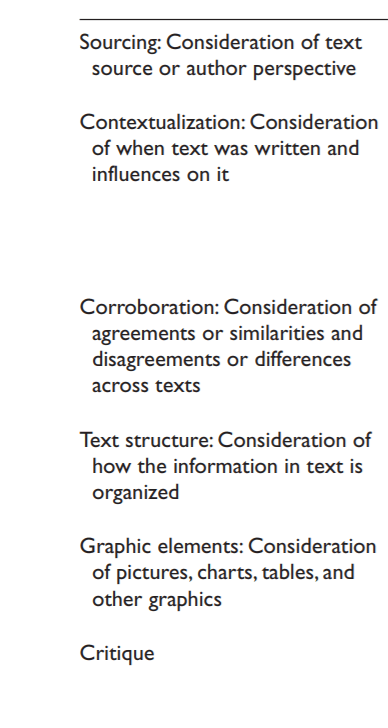
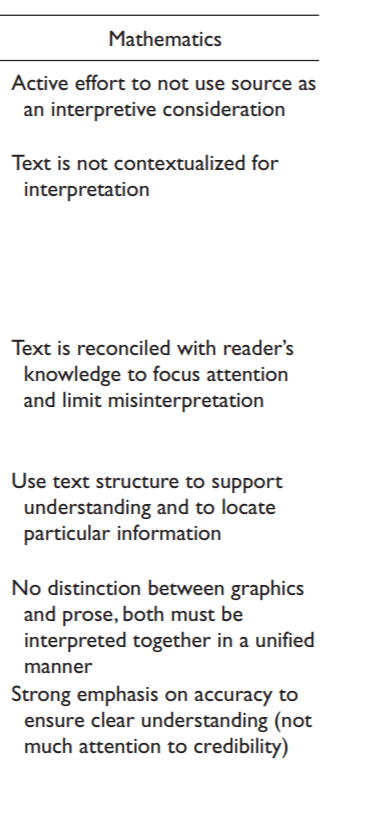
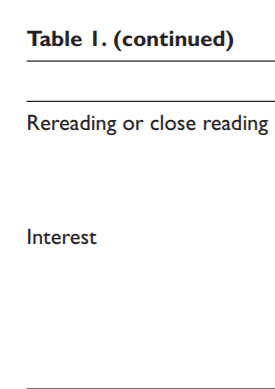
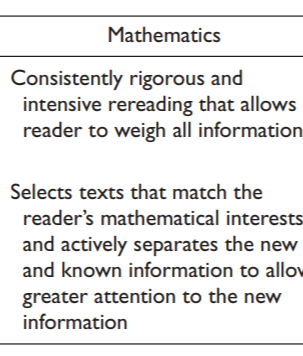
This table is taken directly from the article on pages 406-407 (Shanahan & Shanahan & Misischia, 2011, p.406-407).
Through this study and the data that was collected, I now understand how mathematicians read mathematical texts. This information is really important to know in regard to disciplinary literacy within the content areas. As I have been emphasizing on every one of my blogs, disciplinary literacy is using reading and writing to push students to understand the roots of the content in a specific content area. Our goal as teachers is to use reading and writing strategies to get the students to, in this case, “think like a mathematician.” Furthermore, if the goal of disciplinary literacy is to encourage the students to think like the expert of the content area, then we, as teachers, should understand how those experts think. How can we push and encourage students to stop memorizing content and to rather “think like a mathematician” if we do not even know how a mathematician thinks? The research and data conducted and collected through this study taught me how a mathematician, an expert in the discipline of mathematics, thinks and reasons through a mathematical piece. With this information in mind, I can now apply it to my future teaching to incorporate disciplinary literacy strategies in mathematics to fully encourage my students to “think like a mathematician.”
Based on the data of this study, we see that mathematicians pay very close attention to accuracy when reading a mathematical text. The article expands on this by saying, “The mathematicians in this study were quite forthright about it: If a text includes mathematics, then it is likely to contain error, and part of the math reader’s challenge is to be aware of such error.” (Shanahan & Shanahan & Misischia, 2011, p.422). In other words, mathematicians are constantly looking for errors when reading. A way to apply this mindset of a mathematician to teaching math is to give students worked-out problems that are solved incorrectly in more than one place. The students must then find the errors, fix the errors, and provide an explanation as to why the first solution was incorrect and how their solution is correct. This encourages students to think like a mathematician while also incorporating disciplinary literacy because the students are looking for accuracy and error as mathematicians do while also providing a written explanation.
Another strategy focuses on using both graphics and the text to interpret information. Therefore, I could give the students detailed words problems that require the use of some type of graphic that could be anything from a chart, graph, or diagram. Again, something as simple as this gets the students to think like a mathematician because they are having to interpret the graphic and the text to find the solution to a problem.
The opportunities to incorporate disciplinary literacy into mathematics are truthfully endless. As I have said time and time again, the root of disciplinary literacy is to push the students to think like a mathematician to have them fully understand the content. However, I find it very important that the teacher knows how a mathematician thinks before encouraging this. This study brought attention to this and demonstrated how a mathematician thinks so that I can now implement this data into my own teaching.
Reference:
Shanahan, C., Shanahan, T., & Misischia, C. (2011). Analysis of expert readers in three disciplines: History, mathematics, and chemistry. Journal of Literacy Research, 43(4), 393-429.Wimmer, J. J., Siebert, D., & Draper, R. (2017). Digital mathematics literacies. Journal of Adolescent & Adult Literacy, 60(5), 577-580.

 Happiest Teacher on Earth
Thanks for this thorough run-down of Shanahan, Shanahan and Misischia (2011)–
In looking up the article again I stumbled upon a response to their argument that Mathematicians try not to use texts. The authors, in calling out Shanahan Shanahan and MIsischia by name, “contend that most mathematicians regularly do consider sources when reading mathematical arguments and papers.”
looks like we have a fight!
Weber, K., & Mejia-Ramos, J. P. (2013). The influence of sources in the reading of mathematical text: A reply to Shanahan, Shanahan, and Misischia. Journal of Literacy Research, 45(1), 87-96.
LikeLike